Observe and document
your APIs.
Ship production-ready request logs and live API docs from one place. No multiple schemas, no extra work.
One integration. One UI.
Add a single middleware. Tracelet captures routes, logs traffic, and serves docs. No decorators, no schema definitions.
import express from "express";
import { traceletExpress } from "@tracelet/express";

const app = express();

// Init Tracelet
traceletExpress({app, serviceName: "Your API", environment: "local"});

// Your routes — Tracelet observes them automatically
app.get("/users/:id", (req, res) => {
  res.json({ id: req.params.id, name: "Jane" });
});

app.listen(3000);
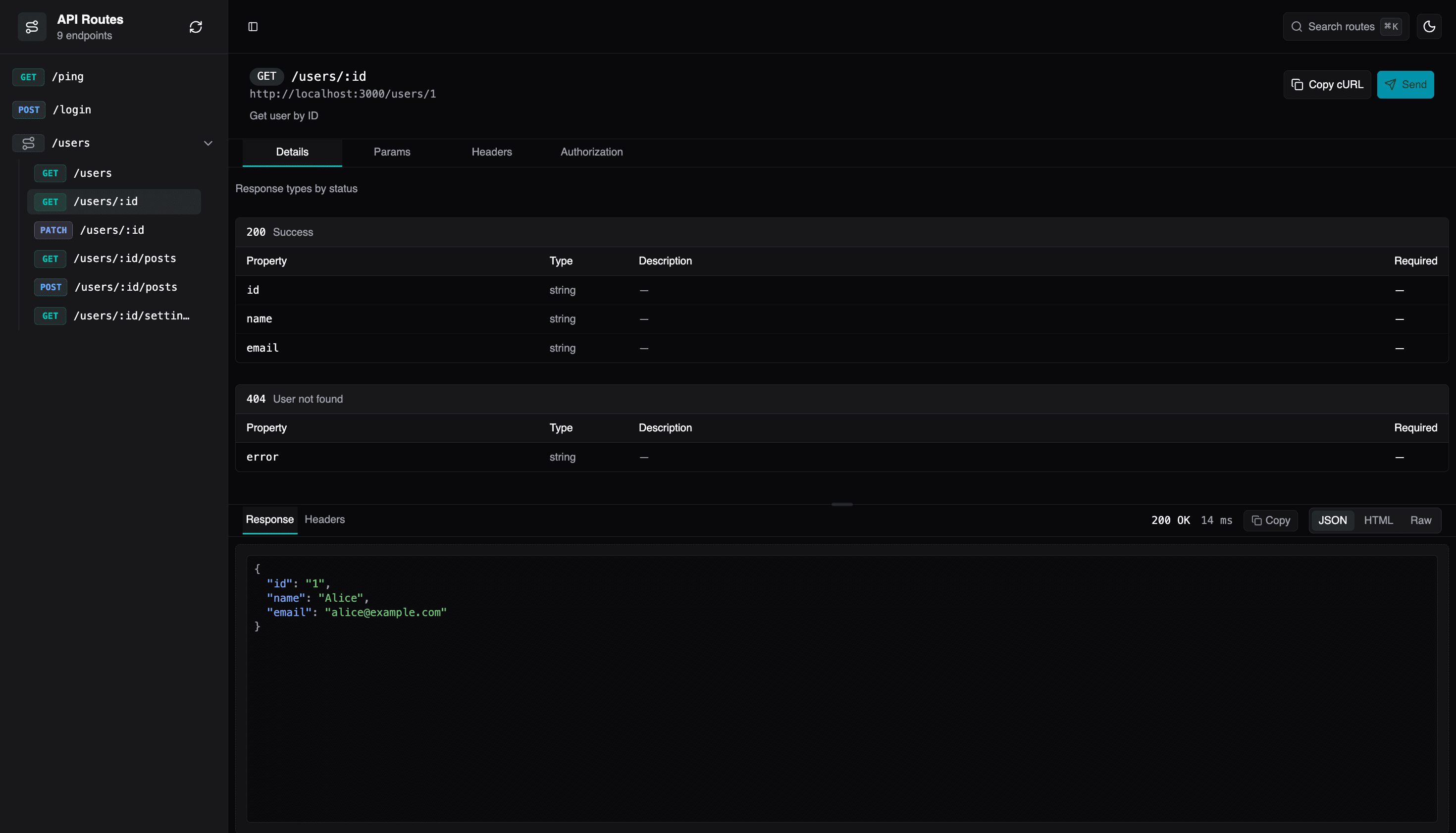
Docs from real routes.
Documentation generated from your running API. Params, body, headers, and response types stay in sync — always.
Production-ready logging.
Request context, payload shapes, response status, and timing. Everything you need to debug without extra tooling.
[Your API] GET    /ping
  304 REDIRECT  4ms  0 B  req:cbb17bc0  trace:cbb17bc0
  2026-02-20T07:01:18.282Z
payload: { ... }
Send requests in the browser.
Edit params, headers, and body. See real responses. Perfect for debugging and sharing with your team.
Why choose Tracelet
One integration. One UI.
Production ready
Ship without maintaining three separate tools. One integration, one UI.
Dark mode compatible
Full light and dark theme support. Matches your environment.
Logs · Docs
Two capabilities in one place. Always in sync with your API.
Built for developers
No route changes, no type hacks, no extra build step. Opt-in and runtime-aware.
TypeScript based
Express-native, type-safe, and designed for modern Node apps.
Copy & paste setup
Install, mount, run. Everything appears at /tracelet-docs.
What is Tracelet
Runtime API observability for Express
The problem
Every tool asks you to describe your API again.
- APIs don't fail because of code — they fail because of visibility gaps.
- Logs live in one place, docs live in another.
- None of them stay in sync.
How Tracelet solves it
Tracelet watches your API instead.
- Runtime API observability layer for Express apps.
- API Documentation and Structured Request & Response Logs.
- All from the same source of truth: your running Express application.
How it works
Three steps. One integration.
Express
Plug inTracelet
ObservesUI
Logs · DocsStep 1
Plug it into Express
typescript
useTracelet(app, {
  serviceName: "payments",
  environment: "dev",
});
Step 2
Tracelet observes routes & traffic
- • HTTP method & full path
- • Request body & headers
- • Response status & shape
- • Execution metadata
Step 3
Everything appears in one UI
Logs · Docs. Available instantly at /tracelet-docs
Built for devs
Designed for developers
Instant setup
Live docs
Structured logs
Express
Runtime observe
Tracelet
API observability
Request logs
Response logs
One integration
API docs
TypeScript
Opt-in, runtime-aware, and non-intrusive.
Typical use cases
- Local development visibility
- Internal service documentation
- Debugging request/response issues
- Frontend ↔ backend collaboration
- Onboarding new engineers
- Microservice observability
Architecture-friendly by design
- Express-native
- TypeScript-first
- No vendor lock-in
- Metadata is exportable
- UI runs on the same port as your API
The larger picture
Don't document APIs. Observe them.
“In a world of scarcity, we treasure tools. In a world of abundance, we treasure taste.”
Tracelet turns your API into its own documentation and logging system.